
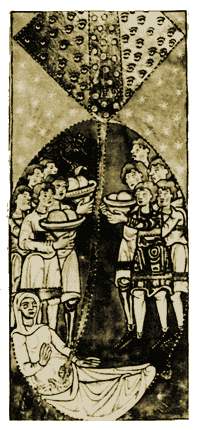
 The
great early 20th century skeptic of science Charles Fort spent a lifetime
thumbing his nose at dogmatic scientific paradigms that claimed to explain
the mysteries of the universe. During his lifetime, Fort documented hundreds
of events (such as rainstorms of crabs and periwinkles) that science could
not explain or for which it could only offer explanations that were as
ludicrous as the events themselves. He called his collection of documented
anomalies the "procession of the damned." They were events relegated
to damnation, darkness, and invisibility because the fetishistically rational
knowledge system of the day had no place for them. Now that science has
grown into extreme complexity, it has begun to produce its own Fortean
events. Below are some highlights from the next generation of the procession
in the areas of biology and reproduction.
The
great early 20th century skeptic of science Charles Fort spent a lifetime
thumbing his nose at dogmatic scientific paradigms that claimed to explain
the mysteries of the universe. During his lifetime, Fort documented hundreds
of events (such as rainstorms of crabs and periwinkles) that science could
not explain or for which it could only offer explanations that were as
ludicrous as the events themselves. He called his collection of documented
anomalies the "procession of the damned." They were events relegated
to damnation, darkness, and invisibility because the fetishistically rational
knowledge system of the day had no place for them. Now that science has
grown into extreme complexity, it has begun to produce its own Fortean
events. Below are some highlights from the next generation of the procession
in the areas of biology and reproduction.
The National Institute of Mental Health and Neurosciences in Bungalore, India, has presented 10 recent cases of children with memories of previous lives who had congenital anomalies that corresponded to wounds each suffered in previous lives. One was born without an arm, and another with malformation of the spine; the remaining eight had birthmarks corresponding to gunshot wounds, knife wounds, burns, or injuries from vehicular accidents.
The Journal of Scientific Exploration has published three case histories of birth defects that were possibly due to cursing at pregnant mothers. Evidently, the shock inflicted on the mother was then passed on to the fetus through a "maternal impression" (a popular concept in the 17th and 18th centuries when the cursing/birth defects correlation was routinely suggested). In the two modern cases, no commonly recognized etiological factors for birth defects could be determined.
Scientists say the odds are 5 million to 1 (in fact, it just can’t happen!), but a black couple has successively given birth to three albino children. Dickson and Cynthia Unoarumhi have produced a Fortean slip that no one can explain.
Scientists from Appalachian State University have presented compelling data suggesting that most births occur in the moon’s third quarter, and that the 21st day of the lunar cycle is the busiest birthing day of the month. Those astrologers may be on to something.
Near Rostock, in Mecklenburg, a woman gave birth to fifteen living children at one time, all of whom remained alive.
In 1709, at Chareaudun, France, the governor's wife, fifty years old, gave birth at the same time to four boys and three girls.The year 1722 was a fruitful year. Many women gave birth to triplets. At Ahorn, near Coburg, a woman gave birth to four boys, and at Corin on the Lossa another woman had four girls. At Petersburg, a poor woman gave birth to six living children. At Arozzo, near Florence, a woman childless during forty-seven years of married life gave birth in her eighty-sixth year to a son.
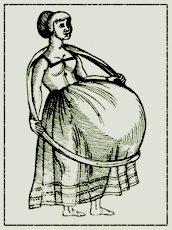
But the following story takes the medal! The sister of Emperor William of Bavaria, who was murdered in 1256, was Margaret, Duchess of Henneberg. Once upon a time a poor woman, carrying twins in her arms, asked her for assistance. But the Duchess drove her away, calling her a whore, saying that it was impossible to have two children at one time from one man. The poor woman called upon God to prove her innocence and prayed that He would cause Margaret to have as many children as there were days in a year; she then went away. At her next confinement the Duchess gave birth to 365 children, all living, each of which was about the size of a little chick, one-half boys and one-half girls; all were baptized by the Bishop of Utrecht, who named all the boys John and all the girls Elizabeth. But they all, as well as the mother, died the same day.
Here’s a useful idea:
Dr. Robert White of Case Western Reserve University has suggested that it’s time for full body transplants. Although the nervous system could not be reconstructed, a person with a dying body could continue to live as a quadriplegic. To prove his case, this postmodern Dr. Frankenstein transplanted rhesus monkey heads onto new monkey bodies. He said the monkeys became rather "pugnacious" after the surgery. The demand for this surgery is apparently very low.
Are New Biology and recombinant animals the wave of the future? Geneticists have crossed a chicken with a quail to get singing (as opposed to chirping) chicks, and have spliced cow and human DNA at the University of Massachusetts to get cow’s milk that contains human breast milk proteins. However, the winner is Professor Masaru Okabe, who crossed a rat with a jellyfish to get a generation of rats that glow in the dark under ultraviolet light--the first living glowing mammals! The bad news is that they won’t be sold to pet shops as novelty pets. But that’s not all.
Researchers in the United Arab Emirates have crossed a camel and llama to get a cama--a more even-tempered creature than the camel that produces wool like the llama and can live under desert conditions. And for those who always wanted a mythic beast, you can get a cross between a sheep and goat that could pass for a chimera. Most of these beasts have no productive value, but they are a cool waste of research dollars--sacrifices that must be made for progress.
Given the latest trend for stirring the genetic stew to invent new animals, the theories of Pierre Grasse may return (especially if we get a couple of escaped mutants introducing themselves into ecosystems), and it may be possible to say once again that evolutionary theory could account for no more than variation within the species boundary (an unacceptable limitation in the era of New Biology). Perhaps we will soon be able to go further and say that points of evolution may have occurred through macromutation that produce "lucky accidents" and "hopeful monsters." The Fortean universe is facing legitimation.
